Ecommerce SEO
Technical SEO Checklist for New Ecommerce Stores (2026)
19 May 2026 · Admin
You can have beautiful product photos and a working checkout — and still get almost no traffic from Google. Technical SEO is the foundation: it tells search engines which pages matter, how fast your store loads on mobile, and what your business actually sells. This guide is a practical checklist for owners launching a new ecommerce store in 2026. If you are working with Infurotech, many of these items ship on day one; if you are evaluating DIY builders or agencies, use this list to ask the right questions before you go live.
What Infurotech does (and how this guide fits)
Infurotech designs, builds, and maintains custom online stores for small and mid-sized businesses — not a self-serve signup where you figure out plugins alone. We scope your catalog and brand on a kickoff call, retune a theme to match your business, connect payments and shipping, and launch on your domain in roughly four to eight weeks. SEO is part of that launch: sitemaps, meta tags, structured data, fast server-rendered pages, and privacy/terms pages wired correctly. This article explains the technical SEO work every store needs; we handle the implementation when you work with us.
Why technical SEO matters before your first sale
Most founders spend launch week on ads and Instagram — then ask why organic search shows nothing. Technical SEO is not the same as writing blog posts (that is content SEO). It is the plumbing: can Google crawl your product URLs? Do they load quickly on a phone? Is there one clear canonical version of each page? Are you accidentally blocking the whole site in robots.txt?
Getting this right before launch is cheaper than fixing indexation six months later. Paid ads stop when you pause budget; organic search compounds. For ecommerce, product and category pages are your long-term assets — they deserve a clean technical base from day one.
Crawlability: robots.txt, sitemaps, and what to index
Every store domain needs two public files search engines expect: robots.txt and an XML sitemap. robots.txt is a small text file at your domain root. It should allow your storefront paths, block admin and staging areas, and point to your sitemap URL. The sitemap is a machine-readable list of URLs you want indexed — home, categories, products, blog posts, and policy pages — not checkout success pages, cart, or internal search results.
After launch, open Google Search Console (free), verify your domain, and submit the sitemap. Do the same in Bing Webmaster Tools if you sell internationally. Without submission, discovery can still happen — but you lose visibility into coverage errors and manual actions.
- robots.txt returns 200 and includes: Sitemap: https://yourdomain.com/sitemap.xml
- Sitemap lists only indexable marketing and catalog URLs
- /admin, /demo, and preview themes are blocked from indexing
- One canonical host: pick www or non-www and 301 redirect the other
- HTTPS everywhere; HTTP URLs redirect to HTTPS
On store.infurotech.com
Our marketing site publishes robots.txt and sitemap.xml automatically. When we launch your live store, we configure the same pattern on your domain so crawlers and AI tools can find your catalog from day one.
On-page SEO: titles, headings, and product copy
Each page you want in search needs a unique title tag (about 50–60 characters), a meta description (about 150–160 characters), exactly one H1, and a logical H2/H3 outline. Product detail pages should explain what the item is in plain language in the first paragraph — not only in specification bullets.
For category pages, write a short intro above the grid. For the homepage, align the H1 with your primary offer (what you sell and who it is for). Duplicate titles across products (“Buy online”) hurt click-through rates and confuse crawlers.
Images need descriptive alt text (“Handloom linen overshirt in sand”) — not “IMG_2841.jpg”. Social sharing needs Open Graph and Twitter card tags so links look professional in WhatsApp and LinkedIn.
- One H1 per page; primary keyword in H1 and at least one H2
- Unique title and meta description per product and category
- Canonical URL on paginated lists and variant URLs
- Internal links from home to top categories and contact
Performance and Core Web Vitals
Google measures real-user experience with Core Web Vitals. The three numbers to know: Largest Contentful Paint (LCP) — how fast the main content appears; Interaction to Next Paint (INP) — how responsive taps and clicks feel; Cumulative Layout Shift (CLS) — whether the page jumps while loading.
Ecommerce sites often fail LCP first because of large hero and product images. Compress images (WebP or AVIF), serve responsive sizes, and lazy-load below the fold. Avoid loading heavy JavaScript on every page if the catalog can be server-rendered.
Run Lighthouse on your homepage and a product page on mobile before you turn on ads. Aim for performance and SEO scores in the 90s. Slow checkout costs conversions even when SEO is perfect.
- LCP under 2.5 seconds on mobile
- INP under 200 milliseconds
- CLS under 0.1
- CDN or edge caching for static assets and images
How we approach speed
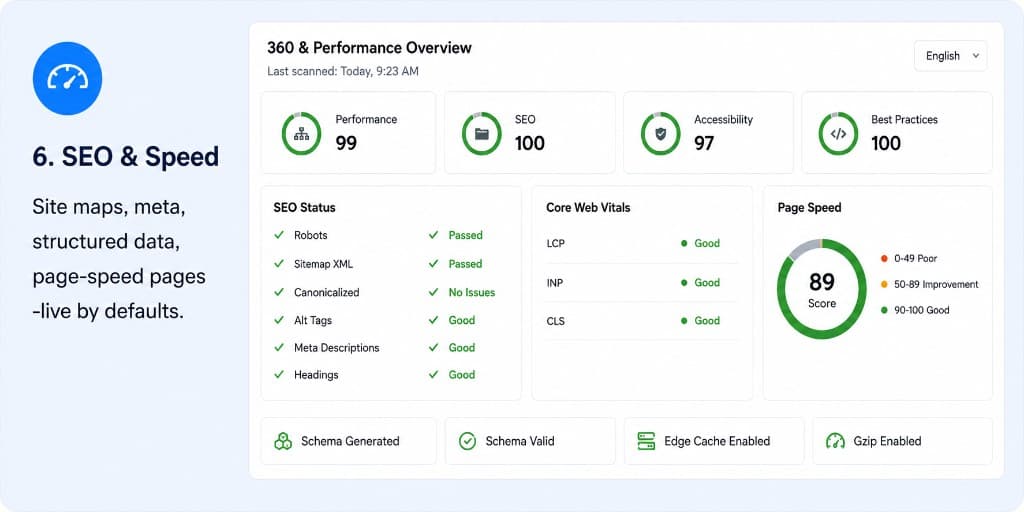
Infuro stores use server-rendered pages, optimized images, and edge caching by default — the same stack we use on this site. Performance is a feature, not a post-launch project.
Structured data, policies, and AI discoverability
Structured data (JSON-LD) helps search engines understand your organization, products, FAQs, and breadcrumbs. Add Organization and WebSite schema on your home page, Product schema on product detail pages, FAQ schema on support content, and BreadcrumbList on nested categories. Validate with Google’s Rich Results Test before launch.
AI assistants (ChatGPT, Gemini, Perplexity) increasingly summarize brands from public web content. They favor clear, factual pages over marketing fluff. Publish an llms.txt file at your domain root with a short summary of what you sell and your main URLs. Keep positioning consistent across your store domain and infurotech.com.
Link to real Privacy and Terms pages from your footer and enquiry forms — not placeholder “#” links. That supports trust for shoppers, regulators, and machines reading your site.
- JSON-LD validates without errors in Rich Results Test
- llms.txt at https://yourdomain.com/llms.txt (optional but useful)
- Privacy and Terms pages linked from footer and forms
- Consistent business name and contact email across the site
DIY builder vs done-for-you store: what to ask
If you compare Shopify, WooCommerce, Wix, or India-focused builders like StoreBase or Instamojo, ask specifically who configures technical SEO. DIY tools give you controls — but someone still must set sitemaps, redirects, schema, and page speed. Agencies may design a beautiful storefront and leave SEO as a line item for later.
Infurotech is a done-for-you model: one team scopes your store, builds on a single commerce platform (storefront, blog, chat, WhatsApp inbox, analytics), and maintains it after launch. You edit products and content; we handle platform updates, monitoring, and technical foundations including SEO.
Clear next step
If you want a store that is designed for your brand and launched with technical SEO already in place, share your catalog, timeline, and channels (web, WhatsApp, marketplaces). We reply within one business day with scope and pricing.
Launch-week checklist (print this)
Run this list the day before go-live and again seven days after. Early fixes prevent months of weak organic traffic and wasted ad spend.
- All customer-facing URLs return 200 (fix redirect chains)
- Search Console verified; sitemap submitted; no “blocked by robots” surprises
- Analytics and purchase conversion events tested end-to-end
- 404 page exists; discontinued products 301 redirect or return 410
- Migration: old URLs mapped with 301 redirects if moving from another platform
- Forms, email notifications, and payment test transaction completed
Summary
Technical SEO for a new ecommerce store comes down to crawlability, unique on-page metadata, speed on mobile, structured data, and trustworthy policy pages. Do this work before you scale ads. If you want the implementation handled as part of a custom store launch — with WhatsApp, payments, and content in one platform — Infurotech is built for that.
FAQ
- When should I do technical SEO for a new store?
- Before launch and again in the first two weeks after go-live. Pre-launch covers robots, sitemap, page speed, and schema. Post-launch covers Search Console, indexing status, and any redirect issues from migration.
- Do I need a sitemap if I only have twenty products?
- Yes. Even small catalogs benefit — the sitemap tells search engines what to crawl and updates when you add categories or blog posts. It also speeds up discovery after launch.
- What Core Web Vitals should I target?
- Aim for LCP under 2.5 seconds, INP under 200 ms, and CLS under 0.1 on mobile. Fix image weight and server response time before chasing advanced optimizations.
- Does Infurotech include SEO in every store launch?
- Yes. Every engagement includes editable meta per page, automatic sitemaps, structured data foundations, fast pages, and policy pages. Larger catalogs or migrations may add scope for redirect mapping and content SEO.
- How is Infurotech different from signing up for Shopify myself?
- Shopify is self-serve software — you choose a theme, install apps, and configure SEO yourself or hire help. Infurotech is a managed launch: we design to your brand, configure the platform, migrate data if needed, and operate the stack after go-live, typically in four to eight weeks.
Ready for a store with SEO built in?
Tell us what you sell and when you want to launch. We reply within one business day.
Start your store